
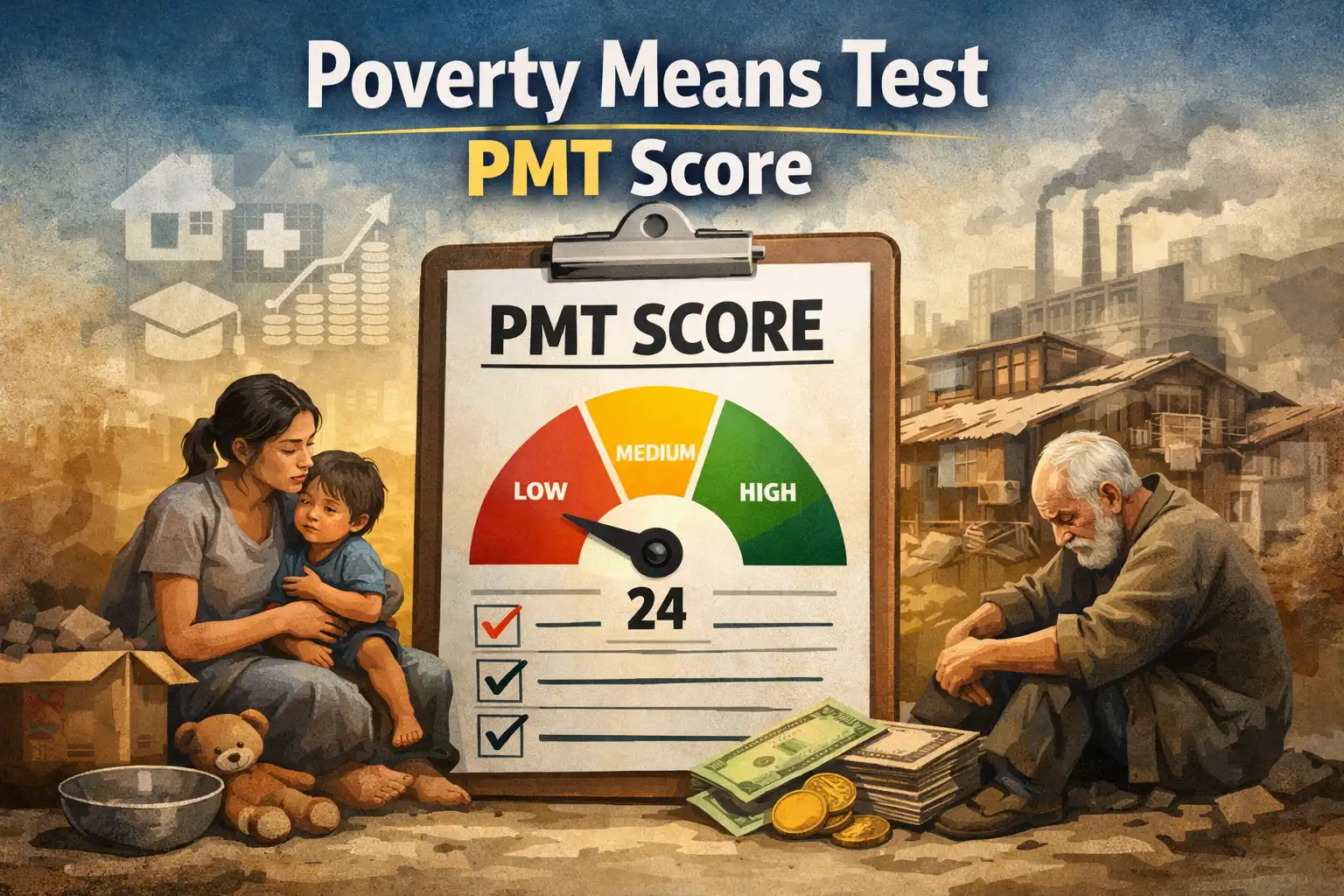
The Poverty Means Test (PMT) score is a government-developed system used to measure the economic condition of households across Pakistan. Instead of relying on income slips or tax documents, which many low-income families do not have, the government assesses poverty using household indicators such as living conditions, education levels, employment type, asset ownership, and family size.
This score helps authorities decide who qualifies for social protection programs such as:
- Benazir Income Support Programme (BISP)
- Ehsaas Kafalat
- Nashonuma
- Taleemi Wazaif
- Emergency relief and cash assistance schemes
In 2026, PMT scoring remains the backbone of Pakistan’s welfare targeting system. It ensures that limited government resources reach families that genuinely need financial assistance, while reducing duplication and misuse.
Why PMT Score Matters for Pakistani Families in 2026
With inflation pressures, rising utility costs, and economic uncertainty continuing into 2026, the demand for government support in Pakistan has increased significantly. However, eligibility is no longer determined by manual recommendations or local committees alone. Instead, your PMT score decides your fate in most welfare programs.
A low PMT score means your household is classified as poor or vulnerable and is likely to qualify for assistance. A high PMT score suggests financial stability, even if your real situation feels difficult, and may lead to rejection. This makes understanding and checking your PMT score not just useful but essential for anyone applying for BISP, Ehsaas, or similar schemes.
How the PMT Score Is Calculated in Pakistan
The PMT score is generated using data collected during the National Socio-Economic Registry (NSER) survey. Enumerators visit households or registration centers collect information, which is then processed through an algorithm to produce a poverty score.
Key factors include:
- Monthly household income and income sources
- Number of household members and dependents
- Type and condition of housing
- Education level of family members
- Employment status and occupation
- Ownership of assets such as vehicles, land, livestock, appliances
- Utility connections such as electricity, gas, and water
In 2026, this system is more integrated with NADRA, utility databases, and national records, which improves accuracy but also means outdated or incorrect data can affect your eligibility more than ever.
PMT Score Ranges and Eligibility in Pakistan
Although thresholds vary slightly by program, most Pakistani welfare schemes use similar PMT benchmarks.
| PMT Score Range | Household Category | Eligibility Status |
|---|---|---|
| 0 to 16.17 | Extremely poor | Almost always eligible |
| 16.18 to 32 | Poor and vulnerable | Usually eligible |
| 32.01 to 40 | Lower-middle income | Conditional or review-based |
| Above 40 | Financially stable | Usually not eligible |
If your score falls below the required cutoff, your application is likely approved automatically. If your score is above the threshold, you may be declared ineligible or asked to update your household data.
How to Check PMT Score Online by CNIC in Pakistan (2026 Method)
Checking your PMT score online using CNIC is now simple and fast in Pakistan. You do not need to visit any office or agent.
Online PMT Score Check Steps
- Enter your 13-digit CNIC number without dashes.
- Submit your information through the official verification system.
- Instantly view your PMT score and eligibility status.
You may see one of the following messages:
- Eligible for assistance
- Under verification
- Not eligible based on PMT score
- Data not found or requires update
In most cases, results appear within seconds.
How to Check PMT Score via SMS in Pakistan
For people without internet access, the SMS method remains active nationwide.
SMS Method
- Type your 13-digit CNIC number
- Send it to 8171
Within moments, you will receive a reply confirming your eligibility or explaining that your PMT score exceeds the required threshold.
This method is widely used in rural areas and among elderly citizens who prefer mobile-based access.
What Your PMT Score Result Really Means
Many applicants assume rejection means permanent ineligibility, but that is not how Pakistan’s PMT system works. Your score reflects your current household profile, not your lifelong financial condition.
If your result shows eligible, it means your PMT score falls within the poverty threshold for the program and you may proceed with biometric verification and payments.
If your result shows not eligible, your household is currently classified as financially stable according to the PMT formula, even if your real income feels insufficient.
If your result shows under verification, your data may be outdated, inconsistent, or flagged for validation. Updating your records can change your status.
Main Reasons for Low or High PMT Scores in Pakistan
Understanding why your PMT score is low or high helps you predict eligibility and correct mistakes.
Housing Condition and Ownership
Families living in rented homes, kacha houses, or informal settlements generally receive lower PMT scores. On the other hand, owning a pucca house, having multiple rooms, or owning property raises your score.
In 2026, property ownership data is increasingly verified through land and municipal records.
Household Income and Job Type
Regular salaried jobs, government employment, or business ownership significantly increase PMT scores. Daily wage laborers, domestic workers, and seasonal workers typically receive lower scores due to income instability.
Even if your income has dropped recently, outdated employment records can keep your score high until updated.
Family Size and Dependency Ratio
Large families with multiple children, elderly members, or disabled dependents tend to receive lower PMT scores because resources are spread across more people. Smaller families with earning adults often score higher.
In 2026, dependency weighting has increased slightly to prioritize households with school-age children and elderly members.
Education Level of Family Members
Households with graduates or skilled professionals receive higher PMT scores due to assumed earning potential, even if they are currently unemployed. Families with low education levels usually score lower.
This factor often surprises applicants who feel financially stressed but are classified as higher-income because of education history.
Ownership of Vehicles, Livestock, and Appliances
Owning motorcycles, cars, agricultural land, livestock, refrigerators, air conditioners, or washing machines can increase your PMT score. The impact depends on the number and value of assets rather than ownership alone.
In 2026, asset data is increasingly cross-checked with national registries and utility connections.
Bank Accounts and Digital Financial Activity
Having a bank account or mobile wallet does not automatically disqualify you, but high transaction volumes or multiple accounts can slightly increase your PMT score. Basic accounts with minimal balances usually do not affect eligibility significantly.
Why Many Deserving Pakistani Families Get Rejected
Many families qualify financially but are rejected due to system issues rather than actual wealth. Common causes include:
- Outdated NSER survey data
- Incorrect household size entries
- Assets registered in a deceased or separated relative’s name
- Old employment records showing stable income
- Property inheritance disputes inflating asset ownership
These problems are increasingly common in 2026 because PMT systems now rely on automated data matching.
How to Reduce a High PMT Score Legally in Pakistan
You cannot manipulate your PMT score, but you can correct inaccurate information that inflates it unfairly.
The most effective actions include:
- Requesting a re-survey after job loss, illness, or financial hardship
- Updating family size due to marriage, death, or new dependents
- Removing assets you no longer own
- Correcting education or employment errors
Once updated, the system recalculates your PMT score automatically based on verified data.
Common Myths About PMT Scores in Pakistan
Many applicants avoid applying due to misinformation. Some common myths include:
- Owning a smartphone disqualifies you automatically
- Having a bank account means instant rejection
- Once rejected, you can never qualify again
- PMT scores never change
In reality, smartphones and basic bank accounts alone do not disqualify you, and PMT scores can change after data updates or re-surveys.
Frequently Asked Questions
How can I check my PMT score online using CNIC in Pakistan?
You can check your PMT score by entering your 13-digit CNIC number through the official verification system or by sending your CNIC via SMS to 8171.
What PMT score is required for BISP eligibility in Pakistan?
Most BISP programs accept households with PMT scores below approximately 32, though thresholds may vary slightly based on policy updates.
Can I change my PMT score manually?
No. You cannot manually change your PMT score, but you can request a re-survey to update incorrect or outdated household data.
How long does PMT re-survey processing take in Pakistan?
In most areas, re-survey processing takes between 2 and 6 weeks from data collection to score update.
Why is my PMT score high even though my income is low?
Common reasons include outdated employment records, asset ownership in your name, higher education levels, or smaller household size.
Does owning a motorcycle disqualify me from BISP?
No. Owning a single low-value motorcycle does not automatically disqualify you, but combined assets can increase your PMT score.
In Pakistan in 2026, the Poverty Means Test (PMT) score plays a decisive role in determining who receives government financial assistance. Knowing how to check your PMT score online by CNIC, understanding what the score means, and identifying why your score might be high or low gives you real control over your eligibility.